



























Bajaj and KTM both shrank their flagship streetfighters under 350cc in the same month this year to dodge the same GST slab, so the real question isn’t displacement anymore, it’s what KTM’s extra ₹94,101 actually buys you.
At ₹1,90,015 ex-showroom, the Bajaj Pulsar NS400Z and the ₹2,84,116 KTM 390 Duke now share almost the same engine capacity (349.13cc versus 349.32cc), near-identical power (40.04 bhp versus 41.5 PS) and torque within half a Newton-metre of each other. Both got there the same way, in the same month: Bajaj cut the NS400Z’s stroke in April 2026 to land just under India’s 350cc GST line, and KTM did the identical thing to the Duke weeks later. The old 399cc Duke didn’t disappear, it got renamed 390 Duke R and pushed up to ₹3,45,293.
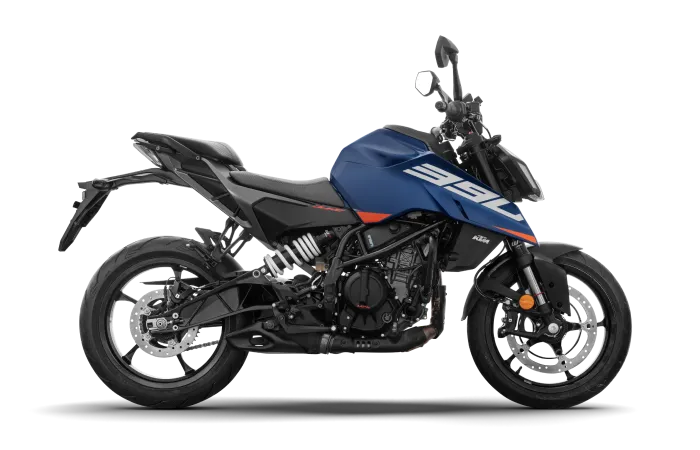
Why Two Rival Brands Both Landed at 349cc
GST 2.0 put motorcycles above 350cc into a 40% tax bracket, while anything at or under that line stays in the 18% slab. Bajaj’s engineers shortened the NS400Z’s stroke from 60mm to 56.1mm and landed at 349.13cc. KTM did the same thing to the 390 Duke’s bore-and-stroke in April 2026, per Rushlane’s report on the launch, landing at 349.32cc. We covered Bajaj’s side of this story in detail when the NS400Z’s TFT update launched on October 1; KTM’s version of the same trick gets far less attention, possibly because the Duke name never advertised a round number like “400” to begin with.
| What Changed (April 2026) | Bajaj Pulsar NS400Z | KTM 390 Duke |
| Old displacement | 373.27cc | 398.6cc (now sold as Duke R) |
| New displacement | 349.13cc | 349.32cc |
| Torque lost | 1.8Nm (35 to 33.2Nm) | 5.5Nm (39 to 33.5Nm) |
| Current ex-showroom price | ₹1,90,015 | ₹2,84,116 |
Pulsar NS400Z vs 390 Duke: Full Spec Comparison
Line the two up today and the brochure numbers are nearly a draw. The gap shows up in the parts that don’t fit on a spec sheet banner: brakes, suspension travel and ground clearance.
| Spec | Pulsar NS400Z | KTM 390 Duke |
| Power | 40.04 bhp @ 9,000rpm | 41.5 PS @ 8,600rpm |
| Torque | 33.2 Nm @ 7,500rpm | 33.5 Nm @ 7,000rpm |
| Kerb weight | 176 kg | 168.3 kg |
| Seat height | 805mm, fixed | 800mm, adjustable to 820mm |
| ABS | Dual-channel, non-cornering | Bosch 9.3 MP, cornering + supermoto ABS |
| Front suspension | 43mm USD, 130mm travel, non-adjustable | 43mm WP APEX USD, 150mm travel, adjustable |
| Ground clearance | 165mm | 183mm |
| Ride modes | 4 (Road, Rain, Sport, Off-Road) | 3 (Street, Rain, Track + Launch Control) |
| Quickshifter | Standard, bi-directional | Standard, bi-directional |
| Cruise control | Not available | Not available |
| Fuel tank | 12 litres | 15 litres |
Is the KTM’s ₹94,101 Premium Actually Worth It?
Not for the engine. The power and torque difference is small enough that you genuinely will not feel it on an Indian road. What you’re paying for is cornering ABS and a Bosch 9.3 MP system that intervenes mid-lean, 20mm more suspension travel with proper compression and rebound adjustability up front, and 18mm more ground clearance, which matters on the broken edges of Indian highways and speed-breaker-heavy city roads where the NS400Z’s lower 165mm clearance will scrape sooner.
Neither bike gets cruise control at this price, which is a genuine miss on both sides given how much highway running these are likely to see on weekend rides out of Pune, Bengaluru or Delhi-NCR. That’s a specific gap, not a vague complaint: TVS already offers it lower down the price ladder on some 310cc models, so it isn’t a cost problem, it’s a choice both Bajaj and KTM made.

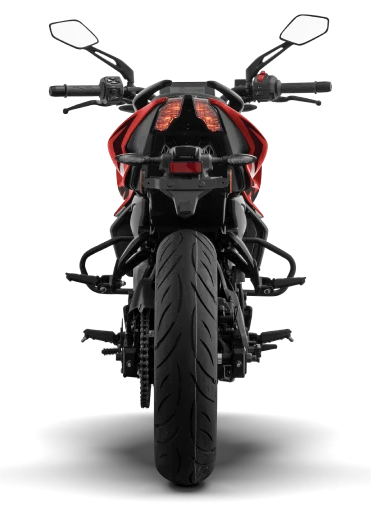
Real-World Mileage: Claimed vs What Riders Actually Report
Autocar India’s instrumented fuel economy test of the NS400Z recorded 27.52 kmpl in mixed city traffic and 29.62 kmpl on a steady highway run at 70-80kph, filling the tank brim-to-brim before and after each leg. That’s a real, attributed figure, not a brochure claim.
For the 390 Duke’s new 349cc engine, the honest answer is that no independent real-world test has been published yet; the bike is too new. KTM and ARAI’s own claimed figure sits at 28.9-30 kmpl. Treat that as a claimed number only until an outlet runs the same brim-to-brim test Autocar ran on the NS400Z.
Which One Should You Actually Buy?
Buy the Pulsar NS400Z if you ride mostly in city and highway traffic and want near-identical performance for ₹94,101 less. Buy the 390 Duke if you regularly ride ghat roads or push hard into corners, where cornering ABS and the extra suspension travel genuinely change how safe the bike feels.
For most Indian buyers cross-shopping this segment on an EMI, the NS400Z is the harder bike to argue against: same power, a standard quickshifter, a useful panic brake alert for India’s tailgating traffic, and a full lakh back in your pocket. The Duke earns its price with electronics you’ll only notice when something goes wrong at speed, which is exactly when you want them. If you’re also weighing the rest of the segment, the full list of 350cc-class bikes on sale in India includes the Dominar 400 and TVS Apache RTR 310 at similar money. You can also run the full spec sheet side by side on The Spec’d’s NS400Z vs 390 Duke comparison page.
Is the Bajaj Pulsar NS400Z still a 400cc motorcycle?
No. Since April 2026 it runs a 349.13cc engine, down from the original 373.27cc, to qualify for India’s lower 18% GST slab on sub-350cc motorcycles. The name on the tank didn’t change, but the engine inside it did.
Does the KTM 390 Duke still have a bigger engine than the Pulsar NS400Z?
Only if you pay extra for the 390 Duke R. The standard 390 Duke now uses a 349.32cc engine, almost identical in size to the NS400Z’s. The old 398.6cc engine lives on only in the Duke R, priced at ₹3,45,293.
Which is better for daily commuting, the NS400Z or the 390 Duke?
The NS400Z is lighter on the wallet and carries a bigger 4-mode ride suite, while the Duke’s 18mm extra ground clearance and cornering ABS matter more on broken roads and in the wet. For pure stop-start city commuting, the cheaper NS400Z’s standard quickshifter and panic brake alert make it the easier daily bike to live with.

