
























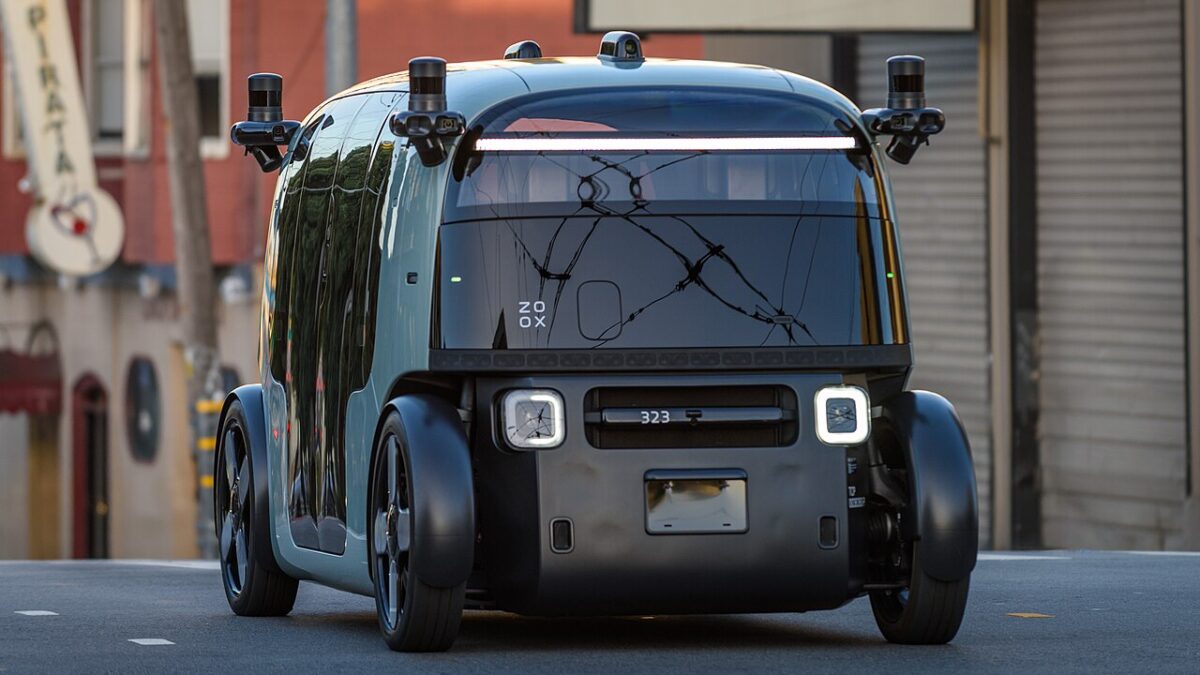
Amazon-owned Zoox just crossed a line no self-driving company has crossed before. Starting August 10, its cube-shaped, all-electric robotaxi began charging real money for rides in Las Vegas. No free trial, no safety driver behind the wheel, and most importantly, no steering wheel or pedals anywhere in the car. This is the first time a purpose-built autonomous vehicle (a car that drives itself using sensors and software instead of a human) with zero human controls has been cleared to run as a paid taxi service in the United States.
Why should this matter to you in India? Because it is the clearest signal yet of where the entire auto industry is heading, and how fast regulators are willing to move once the technology proves itself. Every automaker selling here, from Tata to Hyundai to Mahindra, is racing to pack more ADAS (Advanced Driver Assistance Systems, the tech that helps a car brake, steer or park on its own) into new launches. Zoox just showed what the endgame of that race looks like.
What actually happened
On July 30, America’s top vehicle safety regulator, the NHTSA (National Highway Traffic Safety Administration), granted Zoox a two-year exemption from eight federal safety standards, rules written decades ago that assume every car has a steering wheel and pedals. Zoox’s robotaxi has neither. It is a boxy electric pod with two rows of seats facing each other, a moonroof, sensors packed into every corner, and a top speed of around 75 mph (121 kmph).
NHTSA Administrator Jonathan Morrison did not mince words about why the exemption was granted.
“We can say pretty clearly that the systems in place on the Zoox exceed the equivalent performance requirements of a compliant vehicle. We have the ability to pull the exemption if we see major safety issues.”
That is Jonathan Morrison, NHTSA’s Administrator, putting it plainly: the tech earned this, but the leash stays short.
That warning is not just for show. Zoox had to issue a software recall in July after one of its robotaxis got confused navigating through heavy smoke, a reminder that even the most advanced self-driving systems are still learning to handle the unpredictable situations human drivers deal with by instinct.
How the fares actually work
Zoox is allowed to run up to 2,500 vehicles a year for the next two years, and it is starting with roughly 65 cars on the ground in Las Vegas while production ramps up at its factory. Riders pay a base fare plus a charge for distance and time, much like any Uber or Ola trip, with surcharges for airport runs or drop-offs at busy spots like the Sphere and T-Mobile Arena. Zoox says its pricing is meant to compete with the “comfort” tier on regular ride-hailing apps, not to sit as a novelty premium product.
The company still runs free rides in San Francisco and Austin while it works through state-level approvals there, and it has lined up expansion into Los Angeles and Atlanta next. Every remote operator monitoring the fleet has to be based in the U.S., and Zoox must publish maps of exactly where its cars operate and report crashes or violations to regulators quickly.
Why it matters beyond Las Vegas
Robotaxis without a steering wheel have existed as concepts and test vehicles for years. What is new here is a government agency looking at the safety data and effectively saying this car is safer than one built around a steering wheel it will never use. That is a massive regulatory precedent, and rivals like Waymo and Tesla will be watching closely to see if they can win similar exemptions of their own.
Do not expect steering-wheel-free taxis on Indian streets anytime soon. Our roads, our regulations and our traffic patterns are a different universe altogether. But the underlying technology, the sensors, the software and the safety validation that got Zoox this far, is exactly what is trickling down into the ADAS features showing up in Indian showrooms right now. When a regulator trusts a robotaxi enough to remove the steering wheel entirely, the confidence in autonomous features one rung down the ladder, like lane-keeping, automatic emergency braking and self-parking, only grows faster.


