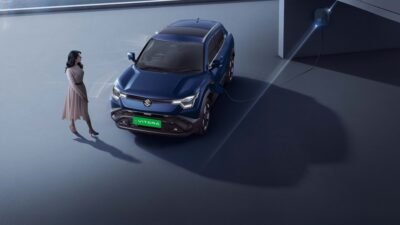
































Maruti Suzuki’s first ever electric car has been sitting in Nexa showrooms since February, but international reviewers who drove it months earlier in Australia and Europe kept saying the same thing: solid effort, but we can’t give a final verdict until we know the price. In India, we’ve known the price since launch. So here’s the answer they couldn’t give.
The e Vitara comes in two setups. A 49 kWh battery drives a single motor at the front, making 106 kW (about 142 bhp) and 193 Nm of torque, enough for a 0 to 100 kmph run in 9.6 seconds. A bigger 61 kWh battery adds a second motor for all-wheel drive (Maruti calls it Allgrip-e), lifting output to 135 kW (181 bhp) and 307 Nm, and cutting that sprint to 7.4 seconds. That’s genuinely brisk for a family SUV.
The range number that matters more than the one on the brochure
Maruti’s official claim for the 61 kWh version is 543 km, tested on the ARAI cycle Indian carmakers use for certification. The same car sold abroad is tested on WLTP, a stricter cycle that tends to sit closer to real-world numbers, and there the 61 kWh battery is rated at just 395 km, with the smaller 49 kWh pack at 344 km. Every EV sold in India has this gap between its ARAI and WLTP numbers, but overseas reviewers who actually drove the e Vitara also flagged that its real-world efficiency lagged behind what they expected. Budget for something closer to 350 to 400 km per charge with the AC on and Indian traffic, not 543.
Charging is respectable: both battery sizes support DC fast charging up to 70 kW, taking you from 10 to 80 percent in around 45 minutes, while home AC charging tops out at 11 kW.
How it drives
This is where the e Vitara wins people over. International testers called it solid, smooth and noticeably more refined than the petrol Vitara, with the AWD Ultra version feeling properly quick off the line. The recurring complaint was the steering, described as a touch slow and vague given how much instant torque an electric motor puts down. The one pedal driving mode, where lifting off the accelerator slows the car hard enough that you rarely need the brake, also didn’t fully convince testers.
The verdict from international first drives: a genuinely composed, likeable electric SUV, let down slightly by numb steering and a one pedal mode that needs more polish.
Cabin, safety and warranty
Inside, this doesn’t feel like a Maruti from five years ago. Dual 10-inch screens, physical buttons kept for climate control instead of buried in a touchscreen, and wireless charging plus ambient lighting on the top Alpha trim. Safety kit includes Level 2 ADAS (driver assist features like adaptive cruise control, which auto-maintains distance from the car ahead, and automatic emergency braking), 7 airbags, and a 5-star Bharat NCAP rating. Maruti backs the battery for 8 years or 1,60,000 km, and the vehicle for 3 years, extendable to 8, reassurance that matters from a brand building its first EV.
Price and variants
| Variant | Battery | Price (ex-showroom) |
| BaaS (base trim) | 49 kWh, battery rented separately | ₹10.99 lakh + ₹3.99/km rental |
| Delta | 49 kWh | ₹15.99 lakh |
| Zeta | 61 kWh | ₹17.49 lakh |
| Alpha | 61 kWh | ₹19.79 lakh |
| Alpha Dual Tone | 61 kWh | ₹20.01 lakh |
Should you buy one?
At ₹15.99 lakh to start, the e Vitara lands right in the middle of India’s electric SUV fight, alongside the Tata Nexon EV, Hyundai Creta Electric and Mahindra BE 6e. It doesn’t have the biggest range or the boldest styling in that group, but it drives with a maturity that genuinely surprised international testers, backed by the dealer network and after-sales trust Maruti has spent decades earning. If you want your first EV to feel familiar rather than experimental, this is the safe pick. If maximum range per rupee is the priority, cross-shop first.