





























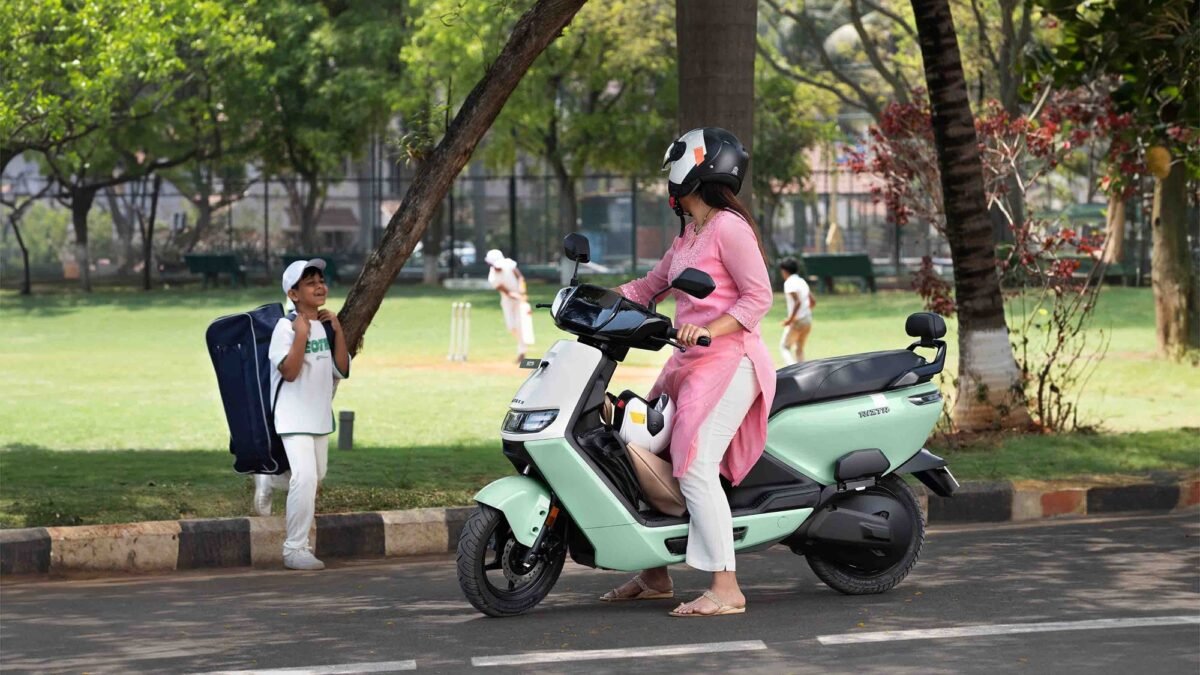
If you have ridden pillion with a family of three on a petrol scooter in city traffic, you already know why “family electric scooter” has become its own segment in India. The Ather Rizta and the Bajaj Chetak are the two names that keep coming up in that conversation, and the choice between them usually comes down to one question: do you want a longer service network and a lower entry price, or a longer real world range and a longer warranty?

Price: Chetak starts cheaper, Rizta catches up at the top
The Bajaj Chetak’s entry variant, the C2501, is priced at ₹91,504 (ex-showroom, Bengaluru) and that is the cheapest way into a “proper” electric scooter from either brand right now. Move up Chetak’s range and prices climb into the ₹1.3 to ₹1.45 lakh band depending on the battery and variant you pick, though exact figures shift slightly by state due to local subsidies and dealer offers.
The Ather Rizta skips the sub-lakh segment entirely. The base Rizta S with the smaller 2.9kWh battery is ₹1,21,499 (ex-showroom), and the range-topping Rizta Z with the 3.7kWh pack is ₹1,36,999. So a Rizta S and a well-specced Chetak end up in roughly the same price zone, it is really the entry-level Chetak that undercuts everything here.
| Spec | Bajaj Chetak (C2501 base) | Ather Rizta S |
| Ex-showroom price | ₹91,504 | ₹1,21,499 |
| Claimed range | Up to 113 km | 123 km real-world, 161 km IDC-certified |
| Top speed | 73 kmph | 80 kmph |
| Peak motor power | ~4.08 kW | 4.3 kW |
| Battery warranty | 3 years / 50,000 km (extendable to 5 yrs / 70,000 km) | Up to 8 years / 80,000 km |
| Body construction | Metal body panels | Predominantly plastic body panels |
Range and running costs: where regen braking earns its keep
On paper the Chetak and Rizta are close, but real-world range is what actually decides whether you charge daily or every other day. Ather’s 123 km “true range” figure for the Rizta S is measured closer to real city conditions than a lab test, which is why it is worth more than it looks against Bajaj’s 113 km claim. Both scooters use regenerative braking, a system that turns the motor into a generator under braking to feed a little charge back into the battery, extending range slightly in stop-start traffic, exactly the kind of riding most Indian commutes involve.

Warranty and service: the Rizta’s real advantage
This is where the gap actually widens. Bajaj covers the Chetak’s battery for 3 years or 50,000 km as standard, extendable to 5 years or 70,000 km at extra cost. Ather backs the Rizta’s battery for up to 8 years or 80,000 km out of the box, a meaningfully longer window on the single most expensive component in either scooter. Against that, Bajaj still has the wider physical footprint: Chetak sells through existing Bajaj two-wheeler dealerships in towns where Ather has no showroom or service center at all, which matters a lot once you are outside the top 20 cities.
If your city already has an Ather Space nearby and you can stretch the budget, the Rizta’s longer real-world range and far longer warranty make it the safer long-term buy. If you are shopping on a tighter budget or outside a metro where Ather’s presence is thin, the Chetak’s lower entry price and Bajaj’s existing service network are hard to argue with.
Both scooters are genuinely built around carrying a passenger comfortably, wide floorboards, usable underseat storage, and a pillion-friendly seat, so neither is a compromise pick if two-up riding is the daily reality. Check the Rizta’s full specs and on-road price or the Chetak’s full specs and on-road price before you decide, and run both through the head-to-head compare tool for your exact variant pick. If you are financing either one, the Rizta’s EMI calculator and Chetak’s EMI calculator will tell you what the monthly number actually looks like against your down payment.