























Fifteen self-driving Mustang Mach-Es are now mixed into London’s regular Uber fleet, safety driver included, as Uber, Waymo, Baidu and Zoox all race to own the robotaxi era.
Uber just put driverless technology on London’s streets for the first time, and it didn’t need a single new car to do it. Starting today, riders who open the Uber app in London can get matched with a Ford Mustang Mach-E that’s driving itself, with a trained safety driver in the seat just in case. It’s a small fleet, just 15 cars, but it’s the moment London’s self-driving race actually started, and it shows where autonomous cars are headed: not a new taxi brand you seek out, but something that quietly shows up inside the app you already use.
What actually launched
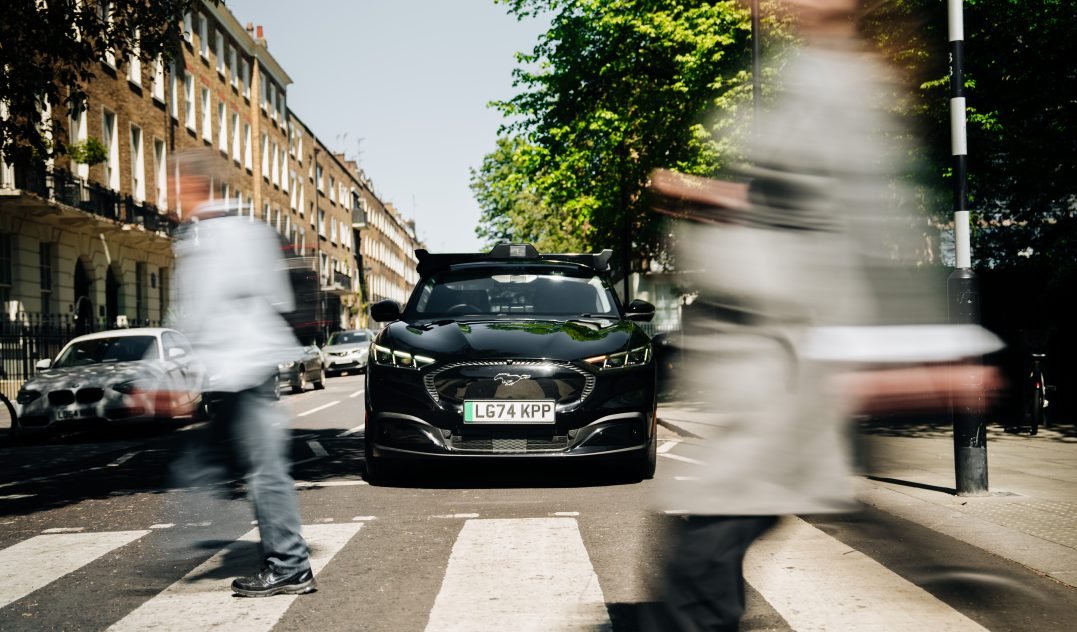
The tech comes from Wayve, a London-founded AI company, running on Ford hardware: 15 all-electric Mustang Mach-E crossovers fitted with Wayve’s self-driving software (its “AI Driver”) and a roof-mounted sensor pod. Book an UberX, Uber Comfort or Uber Electric ride anywhere in London except to or from the airports, and you might be offered one of these cars. Accept it or ask for a normal driver, either way you pay the standard fare. No surge for the novelty, no tip prompt at the end.
A human is still doing the actual supervising. Every car carries a trained, TfL-licensed private hire driver whose job is to watch the road and take the wheel if the software gets it wrong, what the industry calls “supervised autonomy”: the car drives, a person stays ready to intervene. Uber’s Sarfraz Maredia, who runs its autonomous mobility business, admitted the timeline for dropping that safety driver entirely “is still playing out” and depends on UK regulators.
Why London, and why now
This isn’t a stunt with no substance behind it. Wayve has tested its software on London’s roads since 2018 precisely because the city is a brutal proving ground: narrow lanes, double-decker buses, cyclists, and pedestrians who jaywalk freely, legally, unlike in the US. Wayve calls its approach AV2.0: instead of pre-mapping every street in HD detail and hand-coding rules for each situation, the AI Driver is trained to generalise from experience, the way a human learns to drive in one city and copes reasonably well in another. That’s why, the company says, it has tested across more than 500 cities without redoing its mapping work each time.
Regulation matters just as much as the tech. Transport for London granted Wayve’s vehicles Private Hire Vehicle licences on 5 August 2026, and the operation runs under a “triple lock”: the operator (Uber), the driver, and the vehicle itself all need separate licences before a single trip can happen. That’s the UK’s AV Trialling Code of Practice at work, and it’s why this took years even though the tech has road-tested since 2018. Over 140,000 Londoners had opted in through the app hoping to be picked, on top of 100,000-plus on an earlier interest list, a lot of appetite for a service that, at launch, is 15 cars deep.
The race Uber is actually running
Strip away the London specifics and this is Uber picking a side in a bigger fight. Waymo already runs fully driverless taxis (no safety driver at all) across 14 US cities and has said it’s coming to London too. Chinese rivals Baidu and Pony.ai are circling the same city, and Amazon’s Zoox has gone further, building a robotaxi with no steering wheel and charging real fares in Las Vegas since August (we covered that here). Uber’s bet is to not build the driving tech itself: it supplies the app and the riders, while partners like Wayve, Waymo and now Nissan supply the self-driving stack. That way, if one partner stalls, Uber isn’t stuck holding a fleet of unusable cars.
“A major milestone for the future of transport.” UK Transport Secretary Heidi Alexander, on the London launch
A cabinet minister endorsing a robotaxi launch is a signal in itself: the UK wants this industry built at home, not just regulated from the sidelines.
Where Wayve goes next: Tokyo, with Nissan
The more interesting long-term move is what Wayve, Uber and Nissan announced back in March: a plan to bring supervised autonomous rides to Tokyo by late 2026, using Nissan-built EVs running the Wayve AI Driver paired with Nvidia’s Drive Hyperion computing platform. It’s Uber’s first autonomous vehicle deal in Japan, a country with some of the world’s strictest taxi licensing laws, and it fixes a Wayve weak spot: it builds software, not cars. An automaker partner means this driving stack could eventually reach ordinary consumer EVs, not just robotaxi fleets. Nissan’s LEAF, the model most likely to carry it to regular buyers, is worth knowing on its own terms if it’s new to you (our review is here).

What this means beyond London
Wayve has raised over $1.05 billion in one funding round (Series C, led by SoftBank with Nvidia and Microsoft also investing, at a $2.5 billion valuation), which says how seriously investors are taking this. The company plans services in more than ten cities worldwide, and Uber’s pattern with Wayve, Waymo and now Nissan suggests it wants a self-driving option in every major market it operates in.
There’s no confirmed India timeline for any of this: London’s licensing framework alone took years to build, and India doesn’t yet have a comparable structure for driverless testing on public roads. But Uber runs one of its largest global businesses out of India, and tech scaled across continents this actively eventually gets a pilot proposal here too, once the safety case and rules catch up. The useful takeaway for now is what this launch proves, not promises: supervised autonomy, a human on standby but not driving, is what real deployment looks like today, not the pedals-and-steering-wheel-free future from concept videos. That’s the version of this tech that reaches any market first, India included.
The verdict
Fifteen cars won’t change how London moves. But a Transport Secretary endorsing the launch, a licensing system built to allow it, and a partner already lined up for Tokyo say this isn’t a pilot for the sake of a press release. It’s the opening move in a market Uber, Waymo, Baidu and Zoox all intend to fight over for real.
Watch what happens to that safety driver requirement over the next year. The day Wayve’s cars in London lose the person behind the wheel is the day this stops being a curiosity and starts being how taxi rides actually get driven.